
@TheDeFinvestor shared a list of recent DeFi news. If you are not in DeFi every day, the names can feel hard. Below is each item in simple words: what the project is, what it does, and what this news means. 🧭 1) @Uniswap turned on V4 protocol fees 🦄💸 Uniswap is the biggest DEX for swapping coins. What changed: Uniswap turned on protocol fees for many V4 pools. A small protocol fee from swaps is used to buy $UNI on the market and permanently remove those coins (buyback and burn). If trading stays busy, fewer UNI can be left over time. LPs (people who put coins in pools to earn fees) are still arguing about who really pays. 2) @1inch launched Aqua 🌊🔗 1inch is a swap finder-DEX aggregator. It checks many markets and tries to get a better price for one trade. Aqua is a shared liquidity layer. One wallet balance can support several trading positions without locking coins into separate pools. Coins stay in the user’s wallet until a match pulls them. Live on many EVM chains (Ethereum-style networks). Meaning: liquidity providers can put the same capital to work in more places at once. 3) @ethereum Foundation board seat 🛡️ The Ethereum Foundation helps fund and guide core Ethereum work. SEAL 911 is a security response group for crypto emergencies. They added Pavel Caversaccio (SEAL 911 co-founder) to the board. Meaning: a stronger security voice sits closer to Foundation decisions. This is people news, not a new coin feature. 4) @KaitoAI launched Katalyst 📣📊 Kaito is a tool for crypto info and creator campaigns. InfoFi means paying for attention and useful posts about crypto. Katalyst is a new reward system for creator campaigns, built with an X data partnership. Projects pay for measured results (mindshare, clicks, sign-ups, deposits), not only loud posts. Meaning: after X shut down pure pay-to-post farming earlier in 2026, Kaito is trying pay-for-real-results instead. 5) @zama launched Confidential RFQ 🕶️💱 Zama builds privacy tech for public chains. Confidential RFQ (request for quote) is a private swap feature (you ask market makers for a price on a trade, then take a quote). Simple example: without this, you might post a big public trade like “swap a large amount of ETH for USDC.” Bots see the size and direction first and jump the trade (front-running). With Confidential RFQ, you ask for a quote and complete the trade on-chain while size, asset, and direction stay hidden from that open pending stream, so bots have less to jump. Private beta on Ethereum now; wider public use still later. Meaning: better for large private swaps, not a privacy wrap for all daily activity. 6) @AxisFDN Origin Vault went live ⚖️💰 Axis is a new yield project. It tries to earn from arbitrage (buying and selling price gaps across markets in a market-neutral way). Origin Vault opened for USDC/USDT deposits. Early target yield is around 10%–20% base APY plus points. Cap started near $50M and was raised toward $100M after a fast fill. Meaning: another yield product based on trading price gaps. Locks and risk still sit with the user. 7) @grvt_io launched the $GRVT token 📈🏦 @grvt_io is a perps-style derivatives exchange, It runs as a zkSync-based appchain / Validium-style venue on the @zksync stack (zero-knowledge privacy for trading), not a full Hyperliquid-style standalone L1. $GRVT went live around 30 July 2026 (points/airdrop season became a tradeable token). Max supply is fixed at 1B GRVT. Only about 114M is free so far (about 11% of max); the rest is still locked for later vesting. Price About $0.25 | market cap about $28M | fully diluted (if all 1B were free) about $235M–$250M ATH near $0.40 on launch day, then a sharp first-day drop. 8) @alturax says its bank froze redemption money ⚠️🧊 @alturax is a yield app. Users put money in to earn yield. To get cash out, the team often needs to move real bank money into crypto (like USDT) and send it back to users. They say the bank account that holds Altura’s fiat money was temporarily locked by the bank while the bank does a review. Because of that, the planned step “send bank money → buy USDT → pay users who want out” paused. Exact freezable amount is still a team claim ($15m) until the bank finishes and full proof is clear. Soft numbers until then. 9) @0xfluid launched Liquidity as a Service 💧🛠️ @0xfluid is a big DeFi app for swapping and lending, especially strong with stablecoins. If a company issues a new coin (stablecoin, yield coin, or RWA), people need a place to buy and sell it easily. That needs deep liquidity (lots of buy and sell money in the pool so trades do not move the price too much). Building that usually means the issuer puts its own money in, hires market makers, and can take impermanent loss (loss when prices move and the pool leaves you worse than just holding the coins). What LaaS is: Fluid puts its own money into the swap markets for that new coin, runs the positions, and keeps the depth working. The issuer pays Fluid a flat fee. The issuer does not need to put inventory (their own coins/cash) into the pool, and does not take that impermanent loss risk. 10) @injective launched Mint 🏛️📜 Injective is a finance-focused blockchain for trading and tokenized markets. Injective Mint is a platform to issue institutional-grade RWAs (real-world assets like stocks, bonds, or funds as on-chain tokens) with compliance tools built in. Still early (private alpha/beta style). Meaning: an easier path for institutions and agents to mint regulated-style assets on Injective, not only meme coins. 11) @variational_io + Arbitrum Foundation 🤝⛽ Variational is an on-chain perps / derivatives protocol, heavy on @arbitrum. The Arbitrum Foundation is helping with more security audits and sponsored gas (Foundation pays some network fees so early use is cheaper). 12) @LidoFinance released Curated Module v2 🧪🏆 Lido is the largest liquid staking app for Ethereum. Users deposit ETH, get stETH, and can keep using stETH while the ETH earns staking rewards. What CMv2 is: the biggest upgrade to Lido’s main staking system since May 2023. Lido does not run every validator alone. It uses professional node operators (companies that run the computers that stake ETH and secure the network). Before, a lot of trust was about reputation. Now, operators must post ETH bonds (they lock some of their own ETH as a guarantee). If they do a bad job or cause losses, that bond can be hit. So their own money is at risk, not only users’ money. Lido is also shifting a very large pile of staked ETH (about 8 million ETH or more, many billions of dollars) onto newer Ethereum validator designs. That can mean fewer total validators for the same stake, so the network’s validator list can get leaner (smaller count, bigger validators). 13) @fxyzai trading agent went live 🤖💬 @fxyzai is an AI trading agent. A chat bot you talk to in normal language, and it can place trades for you on real markets (not only give tips). It went live on big perps venues including @HyperliquidX, Lighter, and related books (plus Backpack in some product notes). Those places are where a lot of active traders bet on price up or down with leverage. Simple Example: You type something like “open a small long on ETH” or “close my position if price falls.” The agent reads the request, builds the order, and can send it to the exchange interface. You are not clicking every button yourself. You are talking, then the agent acts. It is not a magic money machine. It does not guarantee profit. A bad prompt (unclear or wrong instruction) can open a bad trade. Which of these 13 will normal people actually use in the next 30 days? 👇
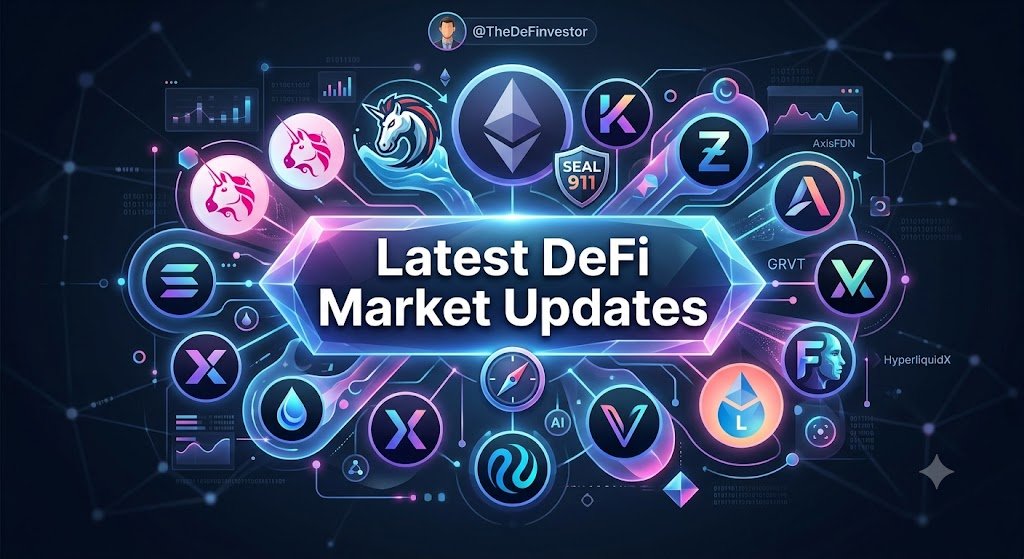
The latest developments in DeFi👇 @Uniswap activated the fee switch on V4 pools for UNI buybacks and burns @1inch launched 1inch Aqua - a shared liquidity layer for DeFi @ethereum Foundation added SEAL 911 cofounder Pavel Caversaccio to its board @KaitoAI introduced Kaito Katalyst - a new InfoFi model in partnership with X @zama launched Zama Confidential RFQ - a mechanism for trading on-chain privately without revealing the size or the asset @AxisFDN, a new project generating yield via arbitrage opportunities, went live @grvt_io launched its token called GRVT @alturax claims its redemption user funds were frozen by its bank @0xfluid launched Fluid Liquidity as a Service - a product that helps asset issuers to bootstrap their liquidity on-chain @injective launched Injective Mint - a platform for issuing institutional-grade RWAs @variational_io partnered with the Arbitrum Foundation to get financial support for expanded security audits and sponsored gas fees @LidoFinance released Curated Module v2 - its biggest upgrade since May 2023 @fxyzai, a native trading agent for Hyperliquid and Lighter, went live I hope you found this recap helpful🫡
· 1.5K Views
