
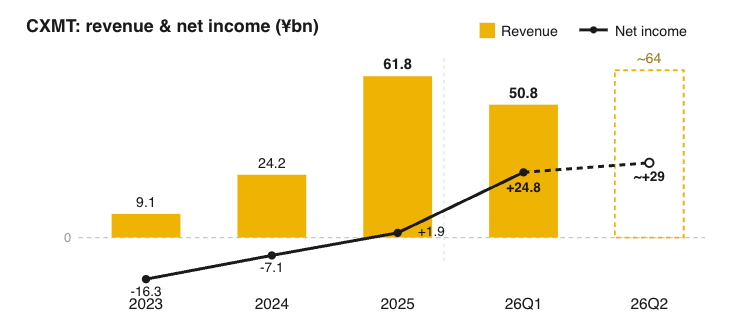
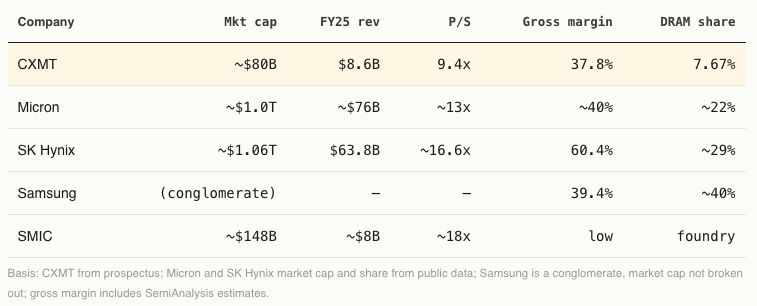
CXMT priced its IPO at ¥579B ($81B). On Hyperliquid, pre-IPO contracts already imply ≈¥3 trillion. Same company. A 5x gap, before it even lists. Here's the full anatomy of that gap. 🧵 —— Start with the order book. 333 institutions bid from ¥7.26 to ¥65 against a ¥8.66 final price — bids spanning 9x on the same company — and total demand ran near 2,000x the shares on offer. The bears and the chasers are both in the room. That's the story of this IPO. —— The bull case is real: China's only pure DRAM maker, from zero to 7.67% global share (No. 4) in ten years. Revenue compounded 161% over three years to ¥61.8B. First profit in 2025, ahead of plan. Capacity (~350K wpm) is closing in on Micron's. The Samsung–Hynix–Micron oligopoly held 95%+ for decades. That door has been cracked. —— Now the discount, quantified. Market cap per 1% of DRAM share: Micron ~$45B. SK Hynix ~$36B. CXMT ~$10B. The market pays the giants 4–5x more for the same share point. That's not irrational — the difference has a name. —— HBM. The giants' trillion-dollar re-rating runs on it. CXMT has essentially none — HBM3 targeted for 2026, HBM3E for 2027, versus the leaders already shipping generations ahead. The tell: its own prospectus barely mentions HBM, and none of the ¥57.9B raised is earmarked for it. The company knows. —— The cost gap has a specific cause, not a vague one. Export controls cut CXMT off from EUV lithography. No EUV → its DDR5 die runs ~40% larger than Samsung's → fewer good chips per wafer → unit costs ~30% above the big three. Its 37.8% gross margin looks peer-level. It's price-driven, not cost-driven. When the cycle turns, it compresses first. —— But the downside is also policy-hardened. Beijing effectively banned Micron from critical infrastructure in 2023, carving out the home market. CXMT is now in 30%+ of domestic Android phones, heading toward 50% — and the shortage has pushed even HP, Dell and Corsair onto its DDR5. State capital (~47% of the register) funds it through downturns. This isn't a cyclical that gets flushed out at the bottom. —— The float makes day one a separate story: only 10% trades, a quarter of that locked in strategic allocations (social security fund, Alibaba ~5%, Tencent, Xiaomi). The chairman pledged no sales for 10 years. A sliver of float on the only pure $DRAM name in A-shares. It can rip on listing day regardless of what it's worth. —— So the frame: policy builds CXMT's floor (state capital, protected home market, ¥500–800B cycle anchor) — and policy caps its ceiling (no EUV, no HBM). Buying CXMT is buying one question: does the HBM gap close? Half the answer is execution. The other half is whether US–China equipment controls ever loosen. NFA.
· 231 Views