
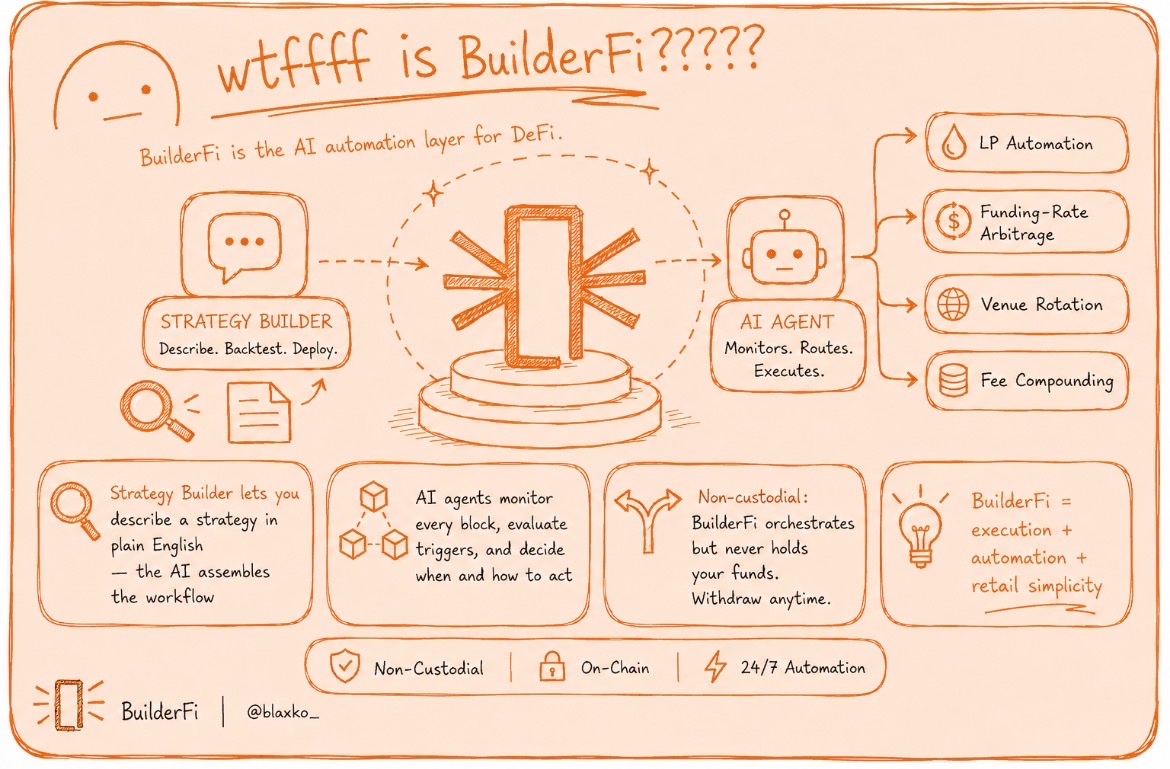
The biggest myth in DeFi is that people lose money because they made the wrong call. But the reality? They lose because they couldn't execute on the right one fast enough. There is a particular kind of frustration that comes from knowing exactly what you should do and watching the window close before you can do it. The rebalance you meant to run at noon that finally happened at midnight. The funding rate that was sitting at 12% when you went to sleep and 3% when you woke up. The LP position that drifted out of range somewhere between dinner and morning and quietly earned nothing while you weren’t watching. The strategy that was right, the timing that wasn’t. For a long time, the people who understood DeFi best were also the most aware of how much they were leaving on the table simply because they couldn’t act on what they knew fast enough, precisely enough or consistently enough. The market doesn’t wait, It doesn’t care that you have a job or that you’re in a different timezone or that you were asleep when the funding rate spiked. It moves and either your position moves with it or it doesn’t and the difference between those two outcomes is almost never about intelligence. It’s about infrastructure. THE INFRASTRUCTURE PROBLEM For most of modern DeFi’s history, the tools that could close the execution gap existed. They just existed inside hedge funds and quant desks and teams of engineers who built them from scratch, maintained them, updated them when protocols changed, and kept them running around the clock. Custom bots. Monitoring systems. Routing engines. Automated rebalancers that knew not just when to move but whether the gas cost made the move worth making. Retail users got to watch, occasionally they got to copy. That asymmetry shaped everything for those who profited or participated. DeFi promised open access and delivered it at the protocol level. Uniswap is open. Hyperliquid is open. Anyone with a wallet can use them. But open access to a protocol and open access to the operational layer sitting above that protocol are two different things entirely. The monitoring, the routing, the timing, the compounding — that layer stayed closed. It stayed inside institutions and well-resourced teams who had the time and capital to build it themselves. The result was a quiet filter. DeFi looked open and honestly atthe surface level, it was but the users capturing the most value weren’t the ones who understood it best. They were the ones who had built the infrastructure to act on what they understood, automatically, at scale, without sleeping through the windows that mattered. That filter is what @builderfiHQ is designed to remove. WHAT BUILDERFI ACTUALLY DOES The user experience is straightforward, even if the infrastructure is complex. You define the target by saying: $10,000 split between ETH/USDC at moderate risk and the platform executes the entire strategy for you. The Range selection, monitoring every block, Gas-aware rebalancing, venue rotation, fee compounding and hedging, running continuously while you do something else. Under the surface, there are three layers working together. The strategy engines; the products you actually use sit on top of an AI agent layer that monitors prices, gas conditions, funding rates, and reward emissions continuously, evaluating trigger conditions every block and deciding when and how to act. Below that is a shared execution layer spanning five chains and eleven protocol integrations, routing actions through optimal paths, batching transactions and settling everything on-chain as verifiable transactions. The architecture matters because of what it enables. Every venue integrated at the execution layer is immediately available to every engine above it, every new integration compounds across the entire platform at once. And because every engine shares the same execution layer, strategies can compose; an LP position, a perp hedge and a lending exit can live in one workflow, running together, interacting with each other executing as a unified system. THE PRODUCTS Three engines are live right now. ➩ LP Automation handles concentrated liquidity end to end. The problem it solves is specific: a concentrated LP position earns fees only while price stays within its range. The moment price drifts out usually overnight, usually when no one is watching, earnings stop. Add the gas costs of mistimed rebalances and the opportunity cost of slow re-entries, and manual LPing quietly underperforms even when the underlying strategy is sound. @builderfiHQ’s LP Automation sets the initial range using realized volatility, monitors drift continuously, rebalances automatically when price approaches the band edge and only executes when the move is worth more than the gas cost to make it. Fees are reinvested continuously. Positions rotate across pools when a better opportunity clears the profitability threshold. The typical retail experience; deposit, check back later, discover you’ve been out of range for six hours becomes the actual experience instead of a recurring disappointment. For DAO treasuries and funds, the same engine runs cross-pool rotation: tracking every integrated stable pool and migrating capital only when the net benefit after gas and slippage clears a meaningful threshold. The treasury sits in the best venue continuously, with zero manual operations. It just runs. ➩ Funding-Rate Arbitrage automates a strategy that experienced traders know well but rarely execute consistently, perpetual futures pay a funding rate between longs and shorts. When funding is positive, shorts get paid. Hold the asset in spot and short the same asset’s perp and the price exposure cancels, what remains is the funding payment, collected market-neutrally. It’s a clean strategy with one significant operational burden: it requires constant monitoring, rotation when rates compress and quick action when risk events trigger. @builderfiHQ’s arbitrage engine scans funding rates across every integrated venue every thirty seconds, filters spreads by depth and minimum profitability, opens long-short pairs simultaneously, collects funding continuously and rotates automatically when conditions change. ➩ The Strategy Builder is where the platform’s ambition becomes most visible. It is a no-code visual canvas plus a scripting layer where you can describe a strategy in plain English — “every Friday at 12 UTC, swap 1% of my USDC to ETH if RSI is below 40 on the 4H” and the AI assembles it into a deployable workflow. Every node is inspectable, nothing is a black box and before any capital is at risk, you run it against five years of historical data covering DEX swaps, LP fees, perp funding and lending rates. Then you deploy with one click. From that point, it runs. Signals fire, the router picks the best venue and path, transactions are batched and settled. A real-time dashboard shows every action the system has taken, each one a verifiable on-chain transaction. There is a kill-switch on every workflow, withdrawals are never locked. The example the BuilderFi team uses is worth sitting with: open an ETH/USDC LP when realized volatility is below 50%, hedge it with a short ETH perp and if volatility exceeds 80%, close the LP and rotate to USDC lending on Aave. One workflow. Three venues. WHO’S THIS FOR? There are two kinds of people DeFi has always struggled to serve well and BuilderFi is built for both of them. ➠ The first is the experienced user who knows exactly what they should be doing and is exhausted by the operational burden of doing it. They understand LP mechanics, funding-rate arbitrage, cross-venue rotation. What they don’t have is the time to execute on that knowledge every day or the infrastructure to automate it without building it from scratch. @builderfiHQ gives them their time back since the knowledge was already there, the platform just handles the execution. ➠ The second is the user who understands crypto but has found DeFi too operationally demanding to start. They hold assets on an exchange, they’ve heard DeFi has more to offer but everytime they’ve looked into it, it felt scattered and technically steep. @builderfiHQ gives them a way in that doesn’t require becoming an expert first; Pick a prebuilt strategy, backtest it, deposit and watch it run. The platform is currently in closed beta. Public launch is planned for Q3 2026, with a waitlist open at builderfi.io for early access. THE MAJOR SHIFT DeFi’s access problem was solved at the protocol level years ago. The barrier was never permission to use the protocol, It was the operational layer sitting between intention and execution; the monitoring, the timing, the routing, the compounding — that quietly filtered out everyone who couldn’t build it or afford someone who could. That layer is what institutions have always had and retail has always lacked. The infrastructure to act on what they knew, automatically, consistently without missing windows because they were asleep or busy or simply human. @builderfiHQ is that infrastructure, built for everyone. The execution gap is closing and for the first time, the limitation isn’t access and it isn’t knowledge, It’s just intention. Early access is open at builderfi.io. Follow @builderfiHQ for updates. OFFICIAL LINKS: ➣ Website: builderfi.io ➣ Twitter / X: x.com/builderfiHQ ➣ Telegram Group: t.me/builderfihq ➣ YouTube: youtube.com/@BuilderFiHQ ➣ Discord: discord.gg/nrwbkWSsT ➣ Resources: docs.builderfi.io
· 1.6K Views


