
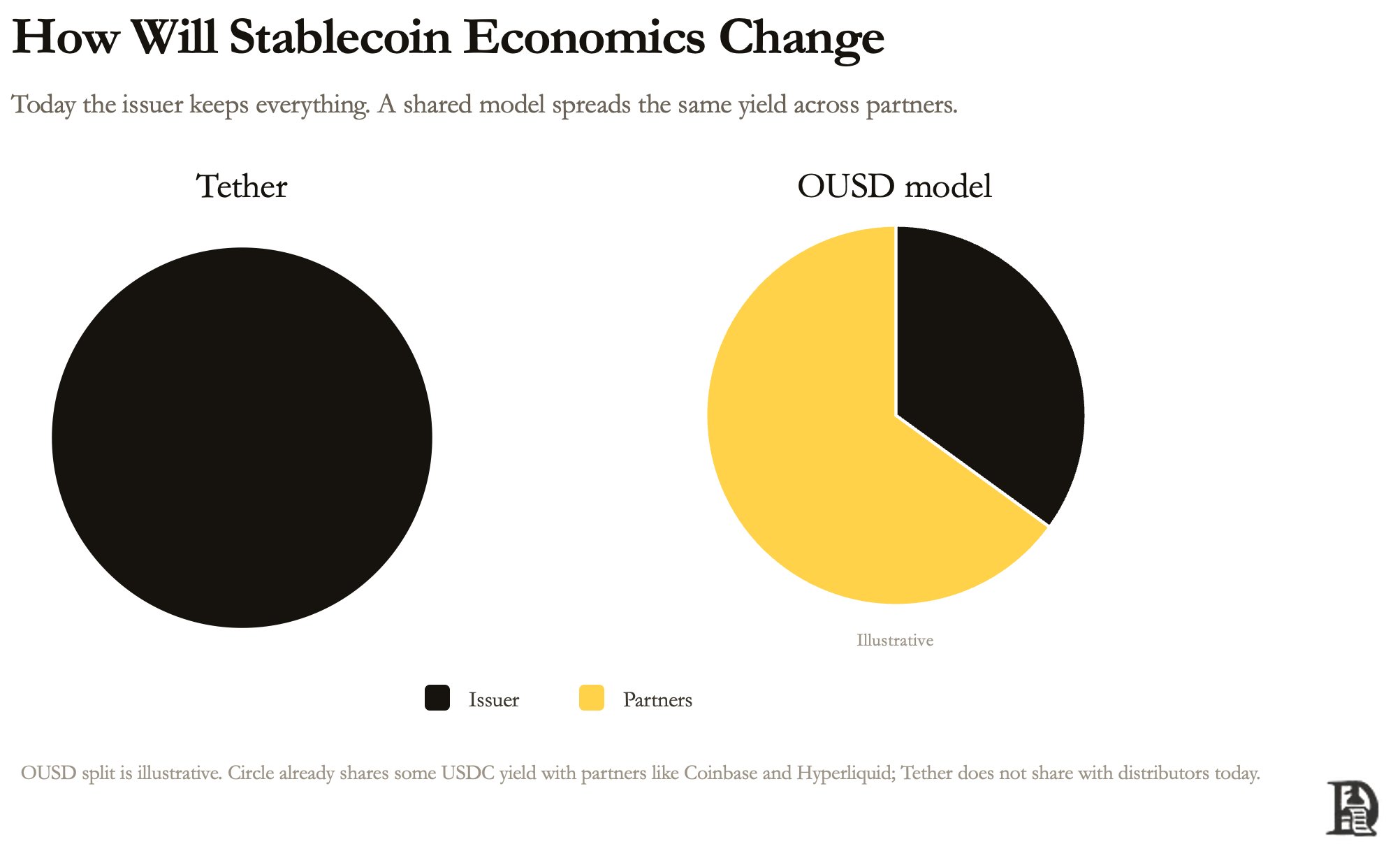
Open Standard launched Open USD. What does this mean for existing issuers like Tether and Circle? Tether and Circle make money the simpler way. They hold your dollars, park them in T-bills, and keep the yield. All of it. Tether made over $10B in net profit in 2025 on roughly $186B in USDT liabilities. The business is making money by holding dollars. Stablecoins can become a $10 trillion market. That’s about 30x from where the total market is today. But it doesn’t get there with the existing use case of financial speculation. The float only reaches that level if businesses use stablecoins for settlement or other use cases. Who wins if stablecoins go to $10T? It’s tempting to think current winners keep winning. They are embedded everywhere in the ecosystem. USDT and USDC together control close to 85% of a $320B stablecoin market. Surely they enjoy network effects with a very solid base. It's the base pair on every exchange, the quote asset on Hyperliquid, the thing every desk defaults to because everyone else defaults to it too. But is that enough? Especially not if the use cases we are going after are beyond speculation. Here are a few reasons why: 1. Liquidity around a base pair is not because of some sworn loyalty. Capital is mercenary. Loyalties change when incentives change. Binance proved this with FDUSD. Zero fees on a handful of pairs in 2023 pushed FDUSD's BTC volume past USDT's within a year. Whoever controls the exchange controls which stablecoin gets called the base pair. 2. Moving between stablecoins keeps getting cheaper. USDT0, the LayerZero-based version of USDT, has already crossed $100B in cumulative cross-chain volume. The technical cost of switching which stablecoin you hold is heading toward zero, which means the "everyone already uses it" argument is a perpetually weakening one. 3. Users are being abstracted away from caring at all. If we are saying that businesses will use stablecoins, they can be abstracted away from users. Once the wallet or the app has control over the underlying asset, the end user just sees dollars. The network-effect argument in favour of existing stablecoin issuers doesn’t hold in this environment. Tether and Circle have created and proved that stablecoin businesses can be viable. That doesn’t guarantee continued success. On the contrary, competition will get more intense. Especially if we anticipate a 30x growth in the existing market. What’s already won is much smaller than what can be won. Netscape created the mass browser category and held a 90% share by the mid-90s. Microsoft bundled Internet Explorer into Windows, cut exclusive deals with PC makers, and took the category over within a few years on distribution, not product quality. New category, then whoever already has scale and distribution absorbs it. The twist with OUSD is that its backers aren't the scrappy new entrants in that story, they're the incumbents. Visa, Mastercard, Stripe, and BlackRock are the distribution for a $10T base. If the bigger player usually wins, OUSD's own consortium may end up winning. Consortiums have a terrible track record of their own. Diem, Facebook's stablecoin consortium, folded in 2022 and sold its assets to Silvergate for $182M after two and a half years of regulatory resistance, despite a regulator reportedly calling it the best-designed stablecoin project the US government had seen. Symbian, the OS alliance Nokia, Sony Ericsson, Motorola and others built to run as one shared platform, was still the most popular smartphone OS worldwide in 2010, then lost that position to Apple's iOS and Google's Android, two single-company platforms that could just move faster than a ten-member board. OUSD seems to be betting it dodges Diem's specific failure mode by staying out of the consumer-facing currency business entirely, positioning itself as infrastructure behind existing brands instead of a brand people are asked to trust directly. What works for OUSD is that value distribution in stablecoins is lopsided toward issuers today, and that changes in one of two ways. Either existing issuers get forced to share it, or new issuers show up already built to share it. We've already seen the first path. Circle spent years keeping all of USDC's reserve income. Then Hyperliquid built enough distribution that Circle had no real choice, USDC became Hyperliquid's "Aligned Quote Asset," and Hyperliquid now keeps up to 90% of the reserve income USDC generates there, an estimated $200M a year, funnelled into buying back HYPE. OUSD is the second path. Same deal, offered to 140 partners on day one instead of being extracted from one issuer at a time. Either way, the question is who actually captures the shared value once it's on the table, and that comes down to who holds these dollars. A processor that moves $10B a month but holds each dollar for eleven seconds has no float worth sharing. The yield only exists if someone holds a balance. Riseworks, the payroll platform, is an example. It's processed $1.5B in lifetime payroll volume, more than half of that now settling in stablecoins. USDC is the dominant share of it. What matters is that workers paid through Riseworks, especially where the local currency is depreciating, don't withdraw the full balance right away. That uncollected float has been Circle and Tether's for free. Under a revenue-share model, it isn't anymore. Riseworks gets a share and can decide whether to pass anything on to the end user (of course, depending on regulations). Plasma, a stablecoin chain that Tether and sister company Bitfinex are investors in, but don't run, holds around $890M in USDT today. At a rate close to its blended reserve yield, that's on the order of $35-45M a year in yield that doesn't flow back to the chain. The same logic holds true for merchant banks and import-export businesses that hold working capital in USDC or USDT across settlement cycles lasting days or weeks. Anyone custodying stablecoin balances on someone else's behalf, long enough for it to matter, has been handing that yield to Tether or Circle for free. So it’s about "who is holding stablecoins on someone else's behalf and earning nothing for it." That category, payroll platforms, remittance corridors, merchant banks, and neobanks, has been running on borrowed economics because there was never a structural reason it had to work that way. Tether can keep making $10B a year for a while yet. That's not what we are focused on. What we want to see is the next $200M-a-year deal like Hyperliquid's become the standard term sheet, whether Tether and Circle end up writing it themselves or OUSD writes it for them.
· 1.9K Views
