
FROM MYTONWALLET TO MY WALLET: THE EVOLUTION FROM A TON-NATIVE WALLET INTO AN 11-CHAIN ONCHAIN PLATFORM Most rebrands change a name, redesign a logo and introduce a new colour palette. This one represents the transformation of an entire product. After years of development, @mywallet_io has officially become My Wallet but this is not simply a cosmetic change. It is the clearest acknowledgement that the platform has evolved beyond being a wallet built mainly for The Open Network. Today, My Wallet is positioning itself as a self-custodial, open-source and increasingly intelligent multichain platform through which users can manage assets, applications, payments, NFTs and other onchain activities across several blockchain ecosystems. THE TECHNICAL BEGINNING: BUILT FOR TON When the wallet entered the market publicly in 2022, its purpose was clear. It was created primarily for the TON ecosystem. At the time, the name MyTonWallet accurately represented a product focused on helping users manage $TON now renamed the-open-network:native alongside Jettons, NFTs, TON DNS assets and decentralised applications built on @ton_blockchain. It also filled an important infrastructure gap. TON needed a capable non-custodial browser wallet through which users could: • Create or import wallets • Hold and transfer assets • Sign blockchain transactions • Connect to TON applications • Manage Jettons and NFTs • Retain control of their private keys The wallet was not custodial. Rather than holding users’ assets on their behalf, it enabled transactions to be signed locally on users’ devices, preserving the principle that access to the recovery phrase means access to the wallet. From there, the project expanded beyond its original Chrome extension into web, desktop, additional browser extensions, Android, iOS and Telegram-based products. What began as a specialised TON tool was gradually becoming a broader Web3 access platform. Original development archive: github.com/mytonwallet/web-ext… Current open-source repository: github.com/mytonwallet-org/myt… Official website: mywallet.io 2024: TRON CREATED THE FIRST REAL MULTICHAIN MOMENT The decisive change began in September 2024. MyTonWallet announced support for @trondao, allowing users to manage $TRX, TRC-20 $USDT and other supported TRON assets alongside their TON holdings. This was a strategically important integration. TRON had already become one of the most widely used networks for stablecoin transfers, particularly for individuals and businesses operating in emerging markets. By integrating TRON, MyTonWallet became useful to users whose everyday cryptocurrency activity extended beyond TON. The team described it as the first wallet within the TON ecosystem to integrate TRON-based assets. More importantly, it represented the beginning of a wider interoperability strategy. At the time, founder Alexander Zinchuk explained that managing assets across multiple blockchains was becoming increasingly important and that the TRON integration was only the beginning. The project also indicated that future expansion could include @solana, @ethereum and BNB Chain. MyTonWallet was no longer thinking exclusively as a TON wallet. It was beginning to build as a multichain wallet. Official My Wallet retrospective covering the September 2024 TRON expansion: mywallet.io/en/blog/v4.7-solan… Contemporaneous report published after the announcement: dig.watch/updates/mytonwallet-… Cointelegraph report republished by Binance: binance.com/en/square/post/139… FROM ASSET STORAGE TO A COMPLETE ONCHAIN PRODUCT While its blockchain coverage was expanding, the wallet itself was also becoming significantly more capable. Across 2024 and 2025, MyTonWallet introduced and improved features including: • An integrated swap aggregator • Connected dApp management • Ledger hardware wallet support • Mobile Ledger connectivity • Push notifications • Improved auto lock settings • NFT card layouts • Wallet personalisation • Improved transaction management • Anti scam protections • Multiple wallet support • Staking functionality • Cross-chain asset management The swap aggregator was particularly important. Instead of requiring users to visit several decentralised exchanges separately, the wallet could compare available swap routes and help users access suitable execution paths from within one interface. Ledger integration also strengthened the product’s security offering by allowing users to combine the convenience of MyTonWallet with hardware-based key protection. These developments demonstrated that the project was no longer merely trying to store assets. It was attempting to become the interface through which users performed their broader onchain activities. Connected dApps, auto-lock and Ledger mobile support: mywallet.io/en/blog/mytonwalle… Swap aggregator, NFT cards and personalisation: mywallet.io/en/blog/swap-aggre… Complete official release archive: mywallet.io/en/blog/ FEBRUARY 2025: ENTERING TELEGRAM DIRECTLY In February 2025, MyTonWallet introduced its Telegram Mini App. This was a natural expansion for a wallet whose original ecosystem was deeply connected to Telegram. The Mini App made it possible for users to access key wallet functionality without leaving the Telegram environment. It reduced the distance between communication and onchain interaction. Instead of treating Telegram merely as a place where communities discussed crypto, the wallet was helping turn it into an interface through which crypto could actually be used. This aligned with the wider development of Telegram-native applications, payments, games and digital communities across TON. The wallet also introduced an expanded help centre to improve onboarding and make its growing collection of features easier to understand. Official Telegram Mini App release: mywallet.io/en/blog/telegram-m… Official product archive: mywallet.io/en/blog/ JULY 2025: @PUSH BROUGHT CRYPTO INTO TELEGRAM CONVERSATIONS One of the project’s most creative products arrived in July 2025 with the introduction of @push. @push allows users to send cryptocurrencies and supported onchain collectibles directly through Telegram conversations. The recipient does not necessarily need to have created a wallet before the transfer is initiated. Instead, the assets can remain secured through a smart contract mechanism until the intended recipient claims them. This addresses one of the biggest problems facing consumer crypto adoption: complexity. Ordinarily, someone sending crypto must request a wallet address, verify the network, confirm that the recipient controls the address and ensure that the selected asset is supported. @push attempts to simplify that process by connecting transfers to the social context in which users already communicate. It combines the convenience of a messaging-based payment experience with the ownership principles of non-custodial blockchain infrastructure. Original official X announcement: x.com/mytonwallet_io/status/19… Official @push release article: mywallet.io/en/blog/push-insta… Official Telegram product: t.me/push 2025: MORE THAN ONE HUNDRED PRODUCT IMPROVEMENTS By the end of 2025, the team described the year as one in which it had launched new products, released native mobile applications and shipped more than one hundred features and improvements. The expanding product included tools such as: • Multisend for distributing assets to several recipients • Quick actions • TON DNS management • Expiration reminders • Pinned Telegram Gifts • Portfolio and net-worth monitoring • An integrated blockchain explorer • Improved wallet galleries • Transaction links • Deposit links • Off-ramping through supported third-party services • Expanded personalisation • Improved NFT and token management These were not isolated cosmetic additions. Collectively, they were turning MyTonWallet into an increasingly complete onchain environment. A user could hold assets, transfer them, exchange them, monitor portfolio performance, inspect blockchain activity, connect to applications and manage collectibles without constantly switching between unrelated tools. Official 2025 recap on X: x.com/mytonwallet_io/status/20… Official chronological release archive: mywallet.io/en/blog/ FEBRUARY 2026: SOLANA CHANGED THE CONVERSATION On 27 February 2026, MyTonWallet officially added support for @solana. This was one of the most important milestones in the wallet’s history. Users gained the ability to: • Create and import Solana wallets • Hold and transfer $SOL • Manage SPL tokens • Send and receive $USDT and $USDC • View supported Solana NFTs • Connect to Solana applications • Perform supported cross chain swaps • Monitor Solana assets through the same interface used for TON and TRON The importance of this integration extended beyond the addition of another popular blockchain. TON, TRON and Solana use different technical architectures, account systems, token standards and application environments. Supporting all three showed that MyTonWallet was no longer simply displaying selected assets from external networks. It was building genuine multichain wallet infrastructure. The Solana integration also introduced an important new audience. MyTonWallet could now serve users involved in Solana DeFi, stablecoins, NFTs, consumer applications and the wider $SOL economy. At this point, the original name was becoming increasingly restrictive. A wallet supporting TON, TRON and Solana could no longer be accurately understood as only a TON wallet. Original official X announcement: x.com/mytonwallet_io/status/20… Official Solana integration release: mywallet.io/en/blog/v4.7-solan… MARCH 2026: THE WALLET BECAME MORE INTELLIGENT The next major release introduced a built-in smart Agent and gasless transfer functionality on Solana. The Agent was designed to make the wallet easier to navigate and allow users to receive assistance while performing supported activities. This reflected a broader change occurring across the wallet industry. Wallets are gradually evolving from passive asset containers into intelligent interfaces that help users understand and execute onchain actions. Gasless transfers addressed another major usability problem. New users often receive a stablecoin such as $USDC but cannot transfer it because they do not yet hold the network’s native gas asset. Through supported gasless functionality, users could perform certain Solana transactions without first manually acquiring $SOL for fees. The current product also advertises gasless functionality for supported activities on TON and Solana. Official release archive containing the My Wallet 4.8 announcement: mywallet.io/en/blog/ Current open-source product repository: github.com/mytonwallet-org/myt… Current Android product information: play.google.com/store/apps/det… APRIL 2026: THE ETHEREUM AND EVM EXPANSION The decisive multichain leap arrived on 30 April 2026. With version 4.9, MyTonWallet added five networks in one major release: • ethereum • base • BNBCHAIN • arbitrum • HyperliquidX This brought the wallet’s total from three supported networks to eight at the time. Ethereum integration gave users access to $ETH and supported ERC-20 assets. Base and Arbitrum extended the wallet into two major Ethereum Layer 2 ecosystems. It is important to represent their tokens accurately: • @base uses $ETH for network fees and does not have an official native “$BASE” token. • @arbitrum also uses $ETH for gas, while $ARB serves as its governance token. • BNB Chain brought support for the $BNB ecosystem, while Hyperliquid expanded the wallet’s reach into the rapidly developing HyperEVM and onchain trading environment associated with $HYPE. The release also introduced subwallets. This allowed users to create and manage multiple addresses under one recovery phrase, offering better separation between different activities, portfolios and onchain identities. Other additions included: • Cross-chain swaps • NFT management across additional networks • Connections to EVM decentralised applications • Redesigned transaction interfaces • Improved wallet and subwallet organisation Ethereum was therefore not merely under consideration. By 30 April 2026, @ethereum, @base, @BNBCHAIN, @arbitrum and @HyperliquidX had been officially integrated. Original official X announcement: x.com/mytonwallet_io/status/20… Official version 4.9 release: mywallet.io/en/blog/v4.9-ether… JUNE 2026: MYTONWALLET BECAME MY WALLET On 17 June 2026, the team officially announced that MyTonWallet was becoming My Wallet. The change included: • A shorter and broader name • A redesigned logo and application icon • A refreshed visual identity • A new official website identity • A transition to the X handle @mywallet_io • Updated branding across its applications and public channels The reason behind the change was straightforward. The platform had grown into something substantially larger than the original name suggested. “TON” accurately described its foundation, but it no longer represented the full scope of the product. The new name My Wallet positions the application as a personal wallet for the wider onchain economy rather than a product associated with only one network. Importantly, the rebrand does not represent an abandonment of TON. TON remains one of the wallet’s foundational ecosystems. The project started with TON, but its future is being built across several chains. Original official rebrand announcement on X: x.com/mywallet_io/status/20671… Official Telegram rebrand communication: t.me/MyWalletEng/129 Official website: mywallet.io Updated terms identifying My Wallet as formerly MyTonWallet: mywallet.io/terms-of-use/ SELF-CUSTODY REMAINS AT THE CENTRE Despite its expansion, My Wallet remains a self-custodial wallet. This means that users not the wallet company control their recovery phrases and private keys. Transactions are signed through the user’s device, and the team cannot independently access or transfer assets from a properly secured wallet. The project is also open-source, allowing its code to be publicly inspected. Its security offering includes: • Ledger hardware wallet support • Locally controlled recovery phrases • Application auto locking • Anti scam protections • Open source code • External security auditing • Transaction confirmation controls • Separation of addresses through subwallets However, self custody also transfers responsibility to the user. Anyone who loses a recovery phrase without a secure backup may permanently lose access to the wallet. Anyone who exposes the phrase to another person may expose the assets controlled by it. The principle remains simple: Your wallet. Your keys. Your responsibility. Official open-source repository: github.com/mytonwallet-org/myt… Official Android security and product information: play.google.com/store/apps/det… Official iOS product information: apps.apple.com/us/app/my-walle… The history of My Wallet can now be summarised through a clear sequence: 2021: Earliest verifiable “My TON Wallet” alpha release. 2022: Public product journey begins as a Chrome extension built for TON. 2024: TRON integration introduces genuine multichain support. 2025: Telegram Mini App, @push, My Wallet Air and more than one hundred product improvements expand the platform. February 2026: Solana integration brings $SOL, SPL assets, NFTs and Solana applications. March 2026: Smart Agent and gasless-transfer functionality improve usability. April 2026: Ethereum, Base, BNB Chain, Arbitrum and Hyperliquid increase supported networks to eight. June 2026: The product rebrands from MyTonWallet to My Wallet and its latest official mobile listings expand the network count to eleven. That is not merely a change of logo. It is the story of a product moving from a browser extension to a complete mobile and desktop ecosystem. From TON-native infrastructure to an 11-chain wallet. From basic asset management to swaps, payments, NFTs, applications, portfolio intelligence and smart assistance. From MyTonWallet to My Wallet. The old name explained where the journey started while the new name tells us where the project intends to go. MyTonWallet is now My Wallet. Not because TON is being left behind, but because the vision has grown beyond one blockchain. One wallet. Eleven networks. A much larger onchain future. Follow the official account: @mywallet_io Official website: mywallet.io
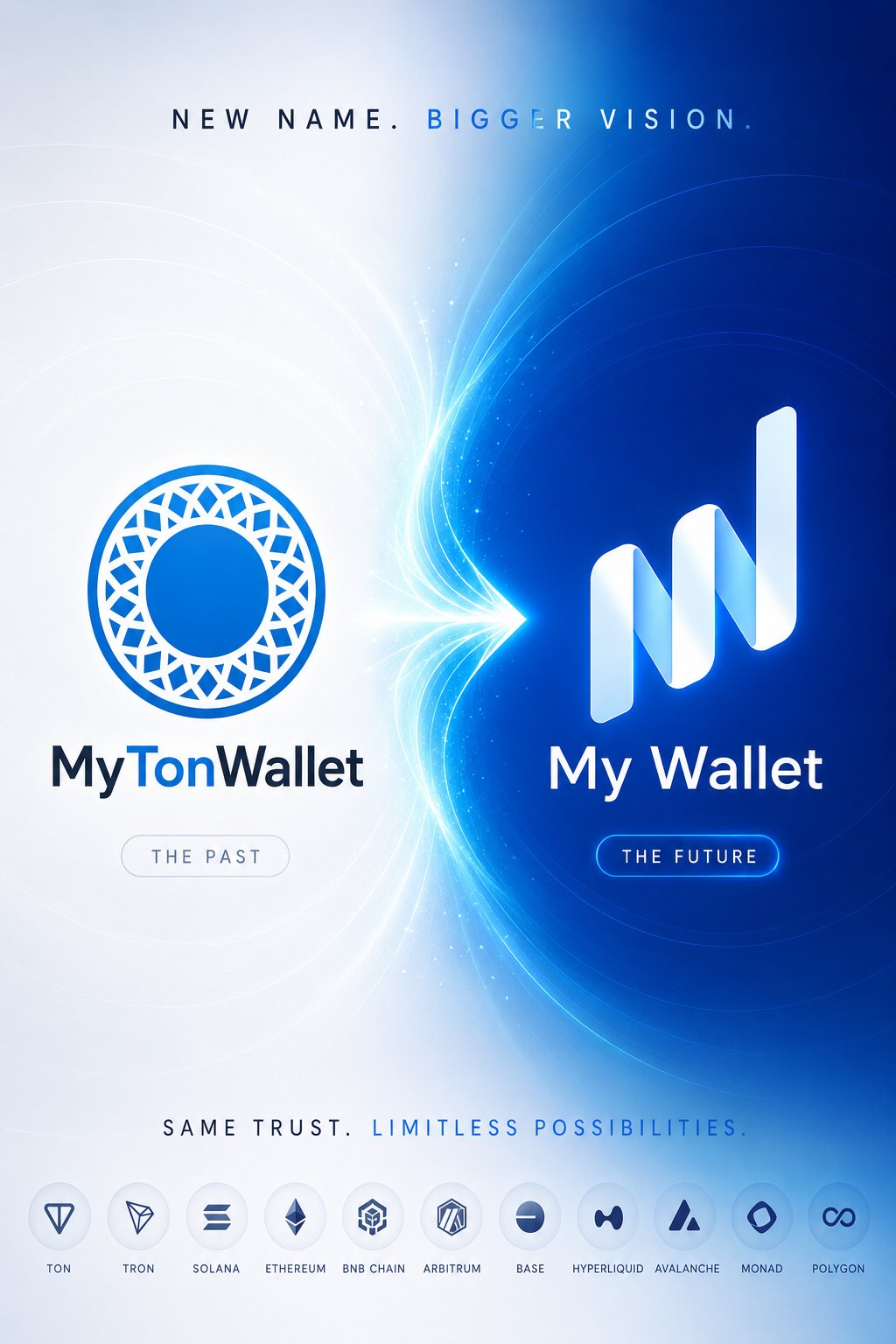
💙 MyTonWallet is becoming My Wallet from the very beginning, MyTonWallet was built with a bigger future in mind. @ton_blockchain was our starting point, but the wallet was always designed to grow beyond a single blockchain. over the past months, we've been actively expanding multichain support across everyday operations. step by step, MyTonWallet has grown into something much bigger than its original name. in terms of features, speed, and user experience, we already exceed the most popular wallets like Trust Wallet, MetaMask, and Phantom, and we have no plans to stop here. that's why this rebranding has been coming for a while. we know many of you saw it coming too: we've seen you suggesting this direction more than once: MyTonWallet → My Wallet more powerful features are on the way: in the coming days, we'll add support for several popular blockchains and major providers in our swap aggregator. here's a little sneak peek: @Bitcoin is the next candidate. should we bring it to My Wallet? 👀
· 1.4K Views


