
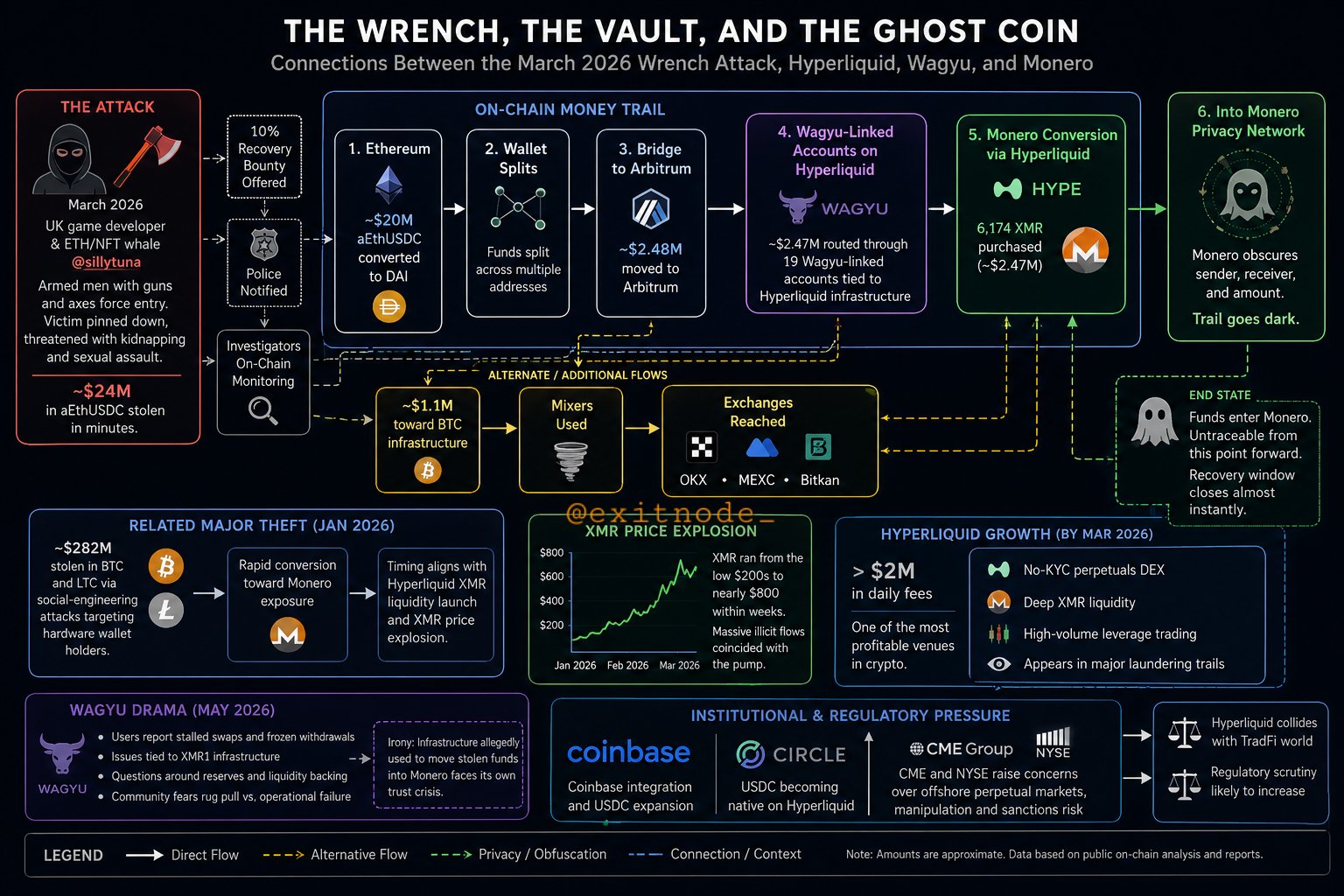
"The Wrench, The Vault, and the Ghost Coin" In March 2026, UK game developer and $ETH/NFT whale @sillytuna opened his door… and found armed men with guns and axes. ~$24M vanished in minutes. Not a hack. A real world wrench attack. He later described being pinned down, bruised, threatened with kidnapping and sexual assault. Axes hovered over his hands and feet. "Grateful to still have all my limbs," he posted afterward. Sillytuna offered a 10% recovery bounty. Police were called. But blockchain investigators noticed something else immediately: the money was already moving with extreme precision. PeckShield, Arkham, and Lookonchain mapped the trail in real time. It led straight into crypto privacy rails. Roughly $20M of stolen crypto was rapidly converted into $DAI on Ethereum. The funds were split across multiple wallets. Classic laundering setup. Then came the bridge. About $2.48M moved onto Arbitrum before the next phase began. The next stop changed everything. About $2.47M flowed through 19 Wagyu linked accounts tied to Hyperliquid infrastructure. Moments later: 6,174 $XMR purchased. Gone into Monero. Investigators could watch the entry point. Not the exit. Another ~$1.1M moved toward Bitcoin infrastructure. Some funds reportedly touched mixers. Other portions hit exchanges including @okx, @MEXC, and @BitKanOfficial. Every movement looked deliberate. Bridges. Wallet splits. Cross chain swaps. Privacy conversions. The speed suggested preparation long before the attack itself. Hyperliquid sat at the center of the story. In January 2026, the no KYC perpetuals DEX enabled deep Monero liquidity through perpetual markets. Then Monero exploded. XMR ran from the low $200s to nearly $800 within weeks. At the same time, massive stolen flows were routed into privacy infrastructure. One of those flows came from a separate January 2026 theft: ~$282M in BTC and LTC stolen through social engineering attacks targeting hardware wallet holders. The stolen funds were rapidly converted toward Monero exposure. Hyperliquid’s XMR liquidity appeared. Huge illicit flows arrived. Monero went vertical. By March 2026, Hyperliquid was generating more than $2M in daily fees. One of crypto’s most profitable venues… while also appearing in laundering trails tied to major thefts. Then the story got bigger. Hyperliquid stopped looking like a niche crypto exchange and started colliding with the traditional financial world. Coinbase integrations. Native $USDC expansion. Growing institutional attention. At the same time, legacy derivatives players publicly raised concerns around offshore perpetual markets and sanctions exposure. The contradiction became difficult to ignore. A platform built around permissionless trading culture was drifting closer to institutional finance… while repeatedly appearing in major privacy coin laundering trails. *Important distinction: There is no public evidence Hyperliquid’s team participated in criminal activity. DEX infrastructure processes whatever users bring to it.* But investigators kept seeing the same rails appear repeatedly. Then came the Wagyu drama. By May 2026, users tied to the same Wagyu-linked XMR infrastructure reported stalled swaps, frozen routes, and withdrawal issues tied to XMR1 systems. Users questioned liquidity backing and reserve transparency. Some feared a rug pull. Others blamed operational failure and panic withdrawals. The irony was impossible to ignore. Infrastructure allegedly used to move stolen funds into Monero was now facing its own trust crisis. Bottom line: A man was beaten in his own home. Millions moved across chains in minutes. The funds hit Hyperliquid linked rails, converted into Monero, and disappeared behind privacy infrastructure before most people even knew the attack happened. And the blockchain recorded every step… until it suddenly couldn’t anymore. End of transmission… for now...
· 776 Views