
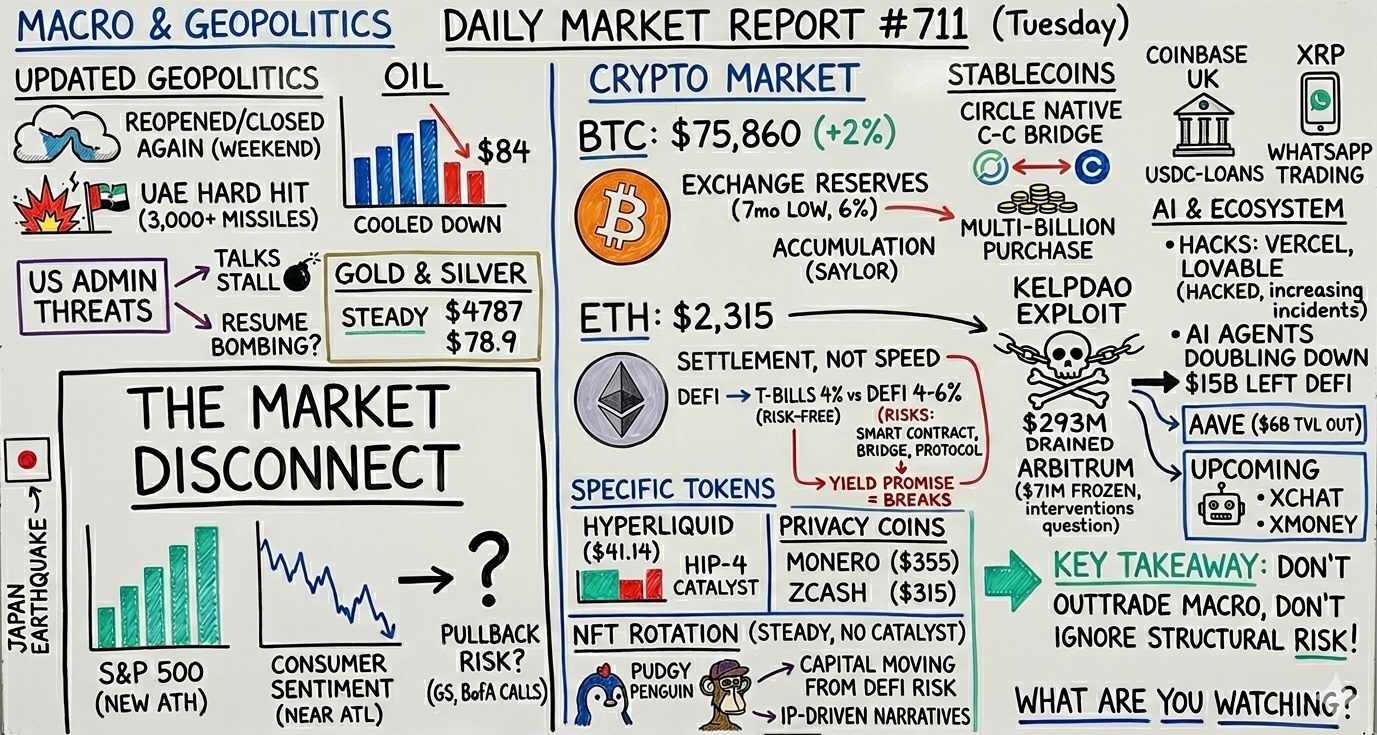
Daily Market Report #711 It’s Tuesday. A solid start to the day, and markets are slightly recovering despite all the recent tensions. The Strait of Hormuz is still one of the biggest stories. Iran reopened and then closed it again over the weekend. The UAE has asked the US for a wartime USD swap line, and it was one of the countries hit hardest, with over 3,000 missiles reported. The US administration is still threatening to resume bombing if talks stall. Let’s see how the week develops. The good thing is we don’t have major macro data releases this week, so the focus stays on geopolitics and market structure. Oil cooled back down to around $84 after yesterday’s spike. Gold is holding steady at $4,787, and silver at $78.9. The S&P 500 is printing new all-time highs while consumer sentiment is near all-time lows. That disconnect remains one of the strongest signals in the market right now. Goldman Sachs and Bank of America are both calling for a near-term pullback. Outside the market, Japan was hit by an earthquake. Looking at crypto, Bitcoin is at $75,860, up around 2%. Exchange reserves are at a seven-month low, around 2.4 million BTC, roughly 6% of total supply. That supports the accumulation narrative. At the same time, large buyers like Saylor continue accumulating, with another multi-billion purchase. Ethereum is at $2,315. There’s ongoing discussion that Ethereum is not built for high-frequency trading, and maybe that’s fine. The real value might be settlement, not speed. That brings back the bigger question: do we actually need DeFi in its current form? If you can earn 4% risk-free in T-bills, why chase 4–6% with smart contract risk, bridge risk, and protocol risk on top? Every cycle promises yield, and every cycle something breaks. Maybe blockchain’s strength is ownership, settlement, and transparency, not yield or speed. The KelpDAO exploit is still one of the biggest stories. Around $293M was drained through a LayerZero-related attack vector. The investigation continues, but the damage is clear. The Ethereum Foundation also mentioned that around 100 North Korean IT workers are active across Web3 companies. That should make everyone rethink hiring and security practices. Since the exploit, around $15B has left DeFi. Aave alone saw roughly $6B in TVL leave. After a year of discussions about revenue models and DAO structures, it turns out users care more about security than tokenomics. Arbitrum froze $71M linked to the exploit. Curve paused LayerZero infrastructure. Multiple protocols are affected. Justin Sun moved around 54,000 ETH from Aave to Spark. That’s not random. That’s risk management. Hyperliquid is at $41.14. Some selling pressure after Arthur Hayes reduced exposure, but the fundamentals still look strong. HIP-4 remains a key catalyst. There’s still strong belief in another leg up, but timing matters. Aster is still sitting at $0.67 with little movement. Chainlink at $9.36 continues pushing integrations. BNB holding steady but still lacking a strong narrative catalyst. Monero is at $355 and Zcash at $315. Privacy coins are holding up better than most in this environment. Starknet introduced STRK20 tokens and continues building out its infrastructure. This could become more relevant, especially around privacy and scaling narratives. Arbitrum is at $0.12 after freezing funds tied to the exploit. It raises the usual question about decentralization versus intervention. Pengu is up around 10% after the recent community activity. At the same time, Abstract XP Day is happening, but sentiment around Abstract is weakening. Xeet announced it will move its assets to another chain, likely due to lack of alignment and incentives. Sui is at $0.94, with ongoing events and ecosystem developments. Worth watching. NFTs are seeing some rotation as capital moves away from DeFi risk. Pudgy Penguins and BAYC are showing signs of life again, as IP-driven narratives come back into focus. On stablecoins, Circle launched a native USDC cross-chain bridge, directly competing with LayerZero and Wormhole. Coinbase rolled out USDC-backed loans in the UK. XRP trading is now live via WhatsApp, showing how retail access keeps expanding. AI continues to move fast. After Vercel, now Lovable was also hacked. The number of incidents is increasing. At the same time, companies are doubling down on AI agents. I’m building out my own stack as well, aiming to ship 15–20 apps. We’re also expecting XChat and XMoney to roll out soon, which could be another interesting step in the broader ecosystem. Overall, a lot is happening across macro, crypto, and AI. The key takeaway remains the same: don’t try to outtrade macro, and don’t ignore structural risk. What are you watching today?
· 772 Views


